- Saturday Sites
- Posts
- Meet the AI Browsers That Might Replace Chrome
Meet the AI Browsers That Might Replace Chrome
AI browsers can now act on your behalf. Here’s why that convenience could quietly kill your privacy.

Caleb Chiang
October 25, 2025 • Estimated Reading Time: 3 minutes

OpenAI quietly launched its new web browser, ChatGPT Atlas, earlier this week — their bold attempt to challenge Chrome’s two-decade dominance.
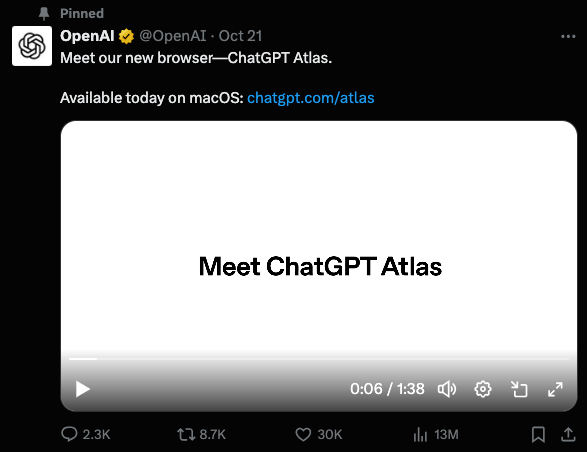
OpenAI announced the new browser on October 21, 2025 via X
Atlas joins a growing class of “agentic browsers” tools that don’t just show you the web but act on it.
In this issue, we’re breaking down the privacy implications of agentic browsers and why researchers (including Brave’s own security team) are warning that this new wave of automation could quietly reshape the risks of browsing itself.
Core Features
Imagine typing a single prompt like “Book me the highest rated one-day tour of Rome on Tripadvisor” and watching the browser navigate to the site, log you in, select a hotel, choose your dates, and confirm the reservation automatically. These are browsers that can take actions on your behalf.

Enter a text prompt to book a tour on Tripadvisor
Alongside competitors like Perplexity’s Comet, these browsers weave AI assistants directly into every tab, capable of summarizing pages, filling forms, and even performing actions on your behalf.
Privacy Implications
Agentic browsers bring a fresh layer of risk. Unlike traditional browsing tools, they integrate automation, decision-making, and multi-step tasks into the browsing experience. That shift creates new weak spots.
Here are the major concerns:
Agentic browsers don’t just follow your commands, they also try to “understand” what’s on the page, including screenshots. That opens the door for websites to sneak in hidden instructions the AI might follow without you realizing it.
Researchers at Brave found that in Perplexity’s Comet browser, attackers could hide invisible text inside an image (like white letters on a white background). The AI would still read that hidden text as a command and act on it, even though you’d never see it.
This means a malicious site could trick the browser into doing things you didn’t ask for, like clicking buttons or sending data somewhere else. Experts say this isn’t a rare glitch either, it’s a widespread weakness in how these AI-powered browsers interpret webpage content.
2.) One Company, Full Access to Your Data
Agentic browsers don’t just remember what page you’re on, they can connect everything you do online. Your tabs, browsing history, saved logins, and even the tasks the AI helps with (like shopping or filling out forms) are all linked together in one system.
That means if the AI ever makes a mistake or gets tricked, it could expose much more than one tab. Possibly your email, banking, or work accounts too.
Normally, browsers keep each tab and site separate to stay safe. But when an AI can move freely between them and take actions for you, that separation starts to break down. What used to be a quick, harmless search could suddenly give the AI access to sensitive parts of your online life.
You’ve probably noticed how ridiculous YouTube ads have gotten lately. Seems like every minute I’m watching a video, an unskippable ad pops up.
That’s why I’ve been using PeterVPN, a simple Chrome extension that blocks ads and keeps my browsing private at the same time.
It’s a one-click VPN that encrypts your connection, hides your IP address, and stops advertisers from following you around the web. I use it daily, not just to block intrusive ads, but to keep my data secure whenever I’m on public Wi-Fi or researching online.
👉 Try PeterVPN and get 20% off for Saturday Sites readers: petervpn.com/ref/SATSITES
Takeaways
Personally, I do not think the convenience of these AI browsers justify the risks assosiated with using them.
When it comes to tasks like booking a hotel or placing a DoorDash order, I’d rather just do it myself on a trusted site using a standard, secure browser. It takes an extra minute, but at least I know exactly what’s happening with my data.
I do not think AI browsers will replace regular browsers anytime soon.
AI browsers like Atlas and Comet are exciting experiments, but they’re still early, untested, and risky. For most people, the best move right now is to watch from the sidelines until the privacy and safety issues are truly solved.
If you found this article useful, share it with a friend who’s curious about AI or privacy and make sure to tune in next week for another breakdown of the latest tools and trends shaping your digital life.
Saturday Sites
Links to related articles: